Blog · Open Source

OpenBridge is not just another bridge. It is an argument for a fairer plugin ecosystem.

OpenBridge was built to keep what the Homebridge world got right, while fixing the parts that shape trust, adoption, and long-term plugin viability behind the scenes.

Nubisco9 min read

Homebridge proved the market for plugin-based HomeKit bridges. OpenBridge starts from a different question: what happens when the runtime becomes more powerful, and the marketplace becomes more democratic?

That question matters because adoption is not only about code quality. It is about who gets discovered, who gets reviewed, who gets installed first, and which plugins are allowed to look legitimate.

OpenBridge was created to improve both the runtime and the distribution model around plugins.
Founder Context

Why this project started

One of the catalysts behind OpenBridge was the experience around homebridge-tuya-local-platform. The plugin itself solved a real problem: robust local Tuya control, broad device support, and more thoughtful abstractions for real homes.

But the surrounding ecosystem highlighted a structural issue. When plugin trust is surfaced through a centralized verification model, visibility stops being purely merit-based. Users install what looks most endorsed. That compounds into more installs, more contributors, and more long-term momentum for the already elevated plugins.

The OpenBridge response

  • Keep the ecosystem open to existing Homebridge-style plugins.
  • Offer a stronger runtime with a built-in UI and API.
  • Create a marketplace where trust is accumulated publicly, not granted opaquely.
Comparison

Why OpenBridge can be a better home for this plugin ecosystem

Host surface

Primarily a bridge host plus plugin flow.

Bridge host plus built-in dashboard, API, live logs, and shell surfaces.

Plugin support

Homebridge platform model.

Compatibility for Homebridge-style platforms plus a native plugin model.

Operational visibility

More dependent on the surrounding host UI and conventions.

Explicit plugin inspection, device telemetry, runtime controls, and config management.

Marketplace Thesis

The marketplace is the real power layer

What OpenBridge Marketplace already does

  • Crawls both homebridge-* and openbridge-* packages from npm.
  • Surfaces ratings, written reviews, and helpfulness signals.
  • Exposes a JSON API that OpenBridge instances can consume directly.
  • Keeps browsing public instead of hiding discovery behind installation context.

Why that matters

Trust should emerge from inspectable evidence: reviews, community signal, maintenance quality, and user experience. A binary verified/unverified world compresses all nuance into one gate.

OpenBridge takes the opposite position: make discovery broader, make feedback public, and let users judge plugins with more context.

Runtime Experience

Better tooling changes what the host platform can be

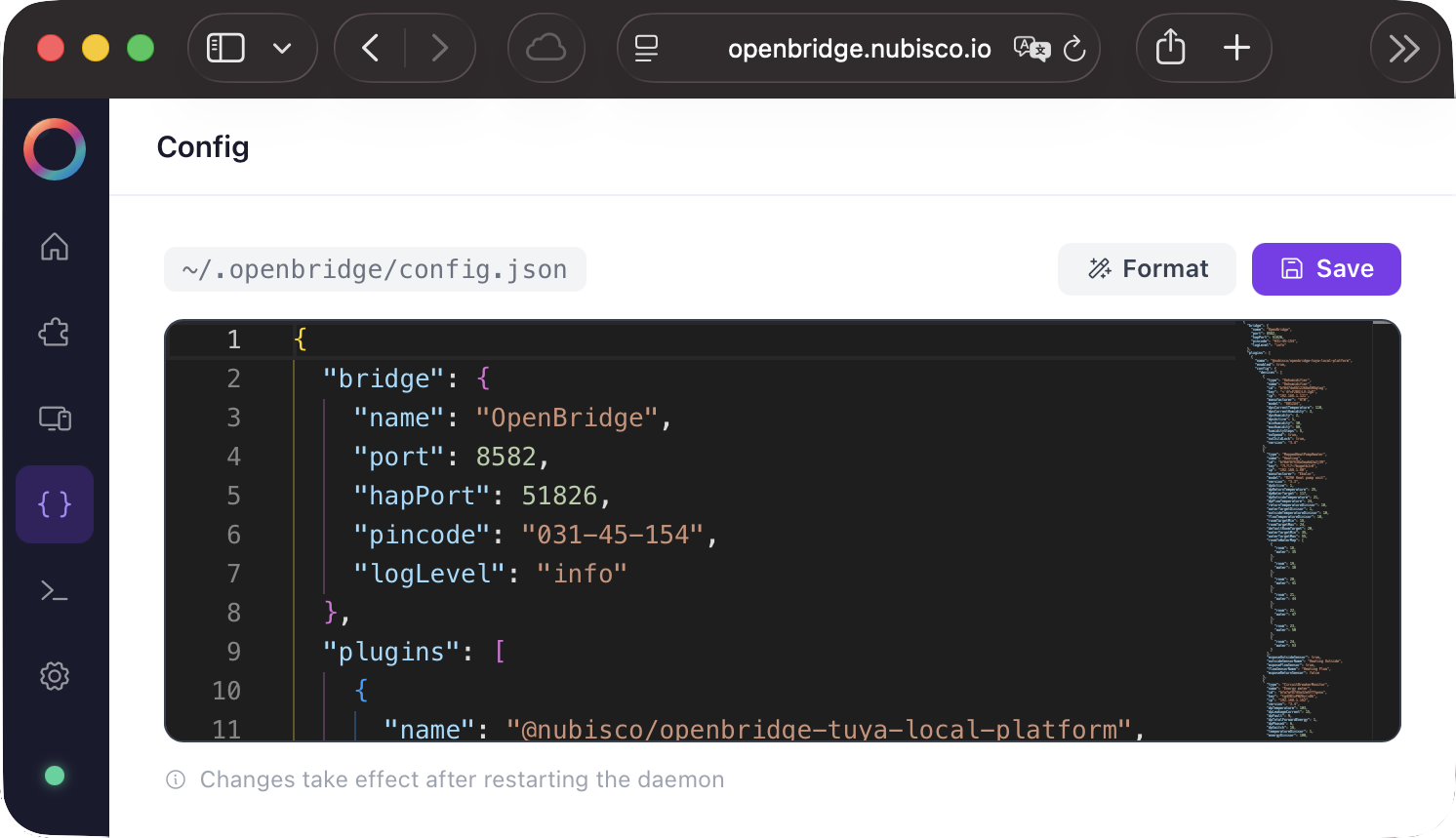
~/.openbridge/config.json
{
  "plugins": [
    {
      "name": "@nubisco/openbridge-tuya-local-platform",
      "enabled": true,
      "config": {
        "devices": [
          {
            "name": "Living Room Heat Pump",
            "type": "MappedHeatPumpHeater",
            "id": "<device-id>",
            "key": "<local-key>"
          }
        ]
      }
    }
  ]
}

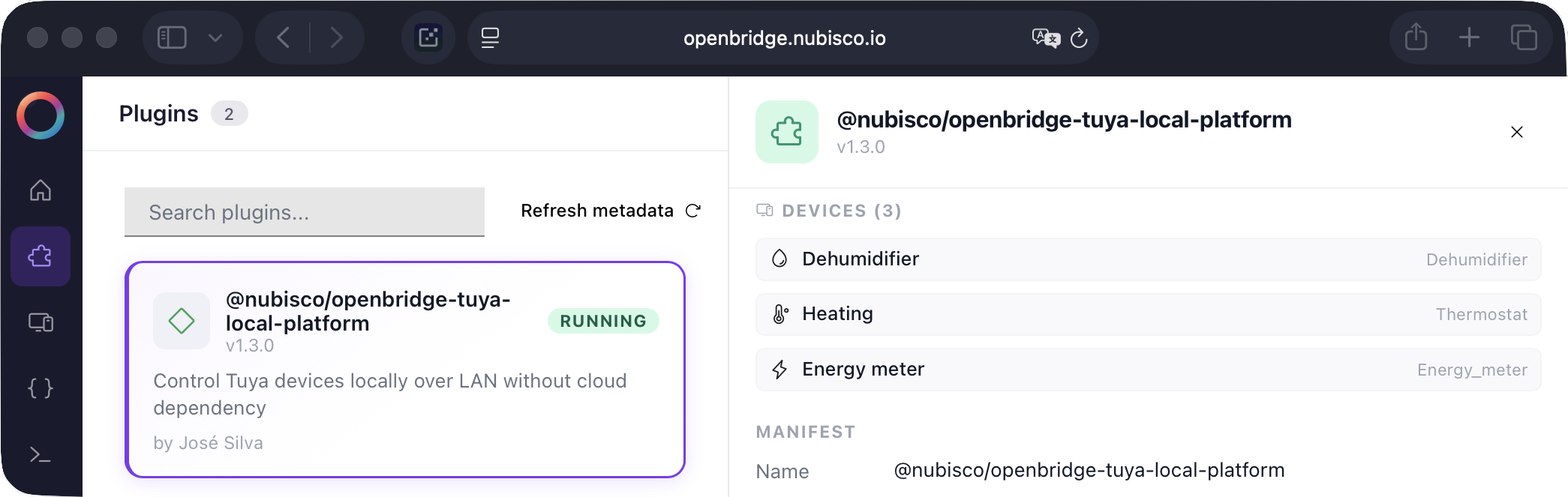
In the OpenBridge UI, configuration is not just raw text in a file. The project already includes a Monaco-backed JSON editor, schema-aware validation, visual config editing for compatible plugins, and plugin inspection surfaces.

That is a concrete example of why OpenBridge is more than compatibility. It gives plugin ecosystems a richer operational product around the code itself.

OpenBridge Monaco editor
OpenBridge config editing with Monaco.
OpenBridge Plugin inspector
OpenBridge plugin inspector.
Plugin Case Study

MappedHeatPumpHeater is the kind of idea this ecosystem should reward

The best part of MappedHeatPumpHeater.accessory.ts is not that it exposes more raw device data. It is that it exposes a better abstraction.

Heat pump devices often think in water temperatures. Humans think in room comfort. The accessory keeps a virtual room target for HomeKit, then maps that target to a water temperature setpoint using a configurable room-to-water table with interpolation.

That means users can aim for a realistic room target, while the plugin translates that intent into device-specific behavior behind the scenes.

Mapped water target43.5°C
  • 18°C room35°C water
  • 20°C room40°C water
  • 22°C room47°C water
  • 24°C room55°C water
Tuya Plugin Delta

What changed from the Homebridge plugin to the OpenBridge plugin

homebridge-tuya-local-platform

  • Registers as a Homebridge platform plugin.
  • Focuses on device integration and Homebridge lifecycle expectations.
  • Exposes the core Tuya local-control engineering work.

openbridge-tuya-local-platform

  • Supports OpenBridge native plugin mode and compatibility mode.
  • Validates startup config with Zod.
  • Registers telemetry and runtime controls into OpenBridge.
  • Connects the same device layer to a stronger host product.

The invitation to the Homebridge community

OpenBridge is not trying to erase what Homebridge accomplished. It is trying to take the ecosystem one step further: preserve compatibility, improve tooling, expand runtime capability, and remove some of the structural bottlenecks that shape trust and adoption.

If a plugin is useful, users should be able to find it. If a plugin is good, it should be able to earn its reputation publicly. If a runtime can do more for both users and developers, it should.

That is the point of OpenBridge.